
Dr Yu-Chieh Hung
Glaucoma, cataract surgeon
MB ChB, PGDipOphthBS, FRANZCO
In 2026, Dr Yu-Chieh Hung joined Southern Eye Specialists, her passion, expertise, and collegiality making the glaucoma specialist and cataract surgeon a welcome addition, both for the team and her patients.
After having worked with most of the consultants here when she was a registrar, Dr Hung fitted seamlessly into “this big family”, as she describes the team. Now moving between roles both here at Southern Eye Specialists and at Christchurch Hospital, Dr Hung’s work is predominantly focused on the treatment of glaucoma and cataracts.
The point of view
“I've always wanted to be a doctor for as long as I can remember,” says Dr Yu-Chieh Hung. In fact, this talented specialist couldn’t imagine doing anything else, and has found herself working in a field that she’d always admired.
Yu-Chieh’s journey into ophthalmology has been somewhat of a linear one.
Stating that she “has always been interested in the life sciences”, Yu-Chieh solidified her future career at high school, taking all the science subjects on offer every year.
“That’s when I began thinking about the different medical specialties,” she says. “My aunt is an anaesthetist, so at that stage, I knew a little about the various specialities. I wanted to do something that involved personal interactions with patients as well as hands-on work.”
She discovered that ophthalmology was “the perfect combination” of the personal and the practical. And witnessing the successes of ophthalmological treatment was also a motivator.
“You're making such a big difference to patients’ lives. They’re not just getting their vision back – they're also regaining their independence.”
So Yu-Chieh travelled south to study medicine at the University of Otago. After graduation, she pursued ophthalmology training, working in Christchurch, Tauranga, and Wellington. She then went to complete a fellowship in glaucoma and neuro-ophthalmology at Royal Perth Hospital, which is also Western Australia’s principal trauma centre.
“We covered quite a big population when on-call so it was a very busy fellowship,” she says. “We'd get people flown down from remote areas and quickly heading into surgery for eye injuries. While it was challenging, you really wanted all the surgical experience that you could get.”
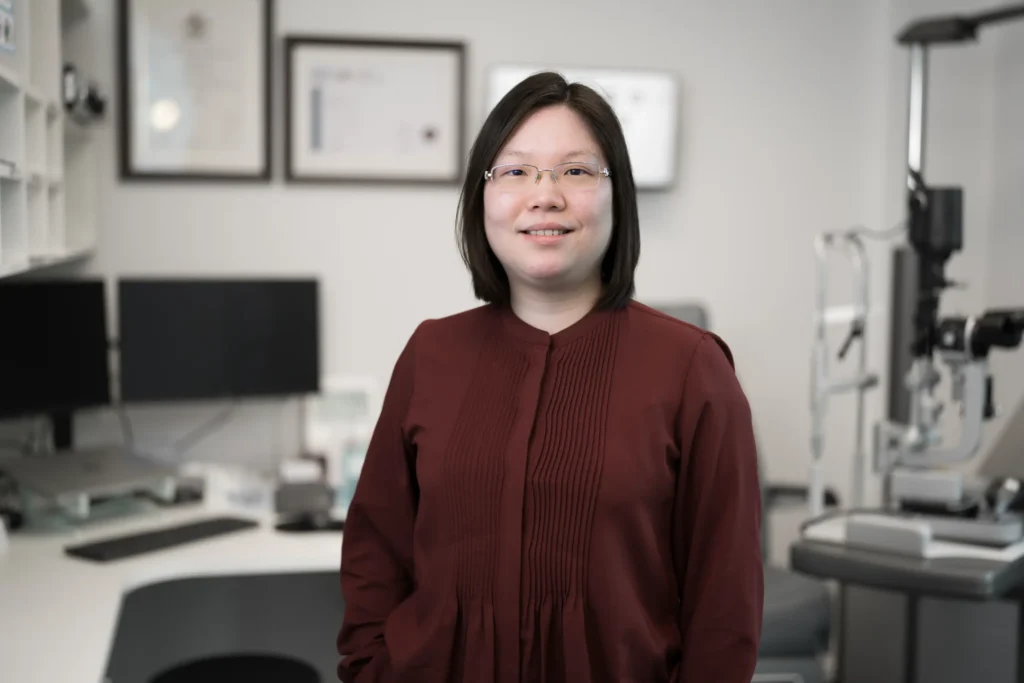
“Being back where my journey started is a really nice feeling. The staff around here are fantastic, and it’s just a really nice place to live in general.”
After the long hours and intense workloads in Western Australia, Yu-Chieh returned to Christchurch, where she says the “the collegial support is amazing.”
“Being back where my journey started is a really nice feeling,” she says. “The staff around here are fantastic, and it’s just a really nice place to live in general. Although it’s a lot colder than Perth, so it did take some getting used to again!”
Working at the cutting edge of ophthalmology is exciting for the young doctor, with ongoing innovation in the assessment and treatment of eye conditions continuing to expand the possibilities for patient care.
In addition to traditional glaucoma surgery (trabeculectomy and tube shunt surgery), Yu-Chieh has also been trained in MIGS (Minimally Invasive Glaucoma Surgery), which is an effective option for some patients with glaucoma, and is generally considered safer than the traditional surgeries, with the added benefit of a faster recovery.
“In terms of cataract surgery, the advancement in intraocular lens technology is significant. There are now many more options available, offering greater flexibility and fewer visual side effects.”
Recent research has led to the introduction of genetic testing to estimate an individual’s risk of developing primary open angle glaucoma, enabling more informed clinical decision-making by helping to distinguish between patients who are likely to benefit from treatment, and those “at low risk of disease progression, who may not require aggressive intervention.”
Being able to tailor management strategies to individual patients is very important to Yu-Chieh.
“In glaucoma management, eye drops are commonly prescribed to limit disease progression. However, adherence can be challenging for some patients. Those with conditions such as arthritis may find it difficult to administer the drops accurately, while others may have trouble remembering to use them consistently. Some patients also experience side effects that may be poorly tolerated.”
“Now there are devices being developed to provide sustained release of glaucoma medications into the eye without having to rely on eye drops,” Yu-Chieh says. “One promising development is an intraocular lens currently in clinical trials that slowly releases glaucoma medication following cataract surgery.”
“With all these different subspecialties in one place, it is a lot easier for the patients. It is a lot easier for me too – if I refer (a patient) to a colleague, I know they’re getting the best care.”
Dr Hung rounds out an experienced group of specialist glaucoma consultants at Southern Eye Specialists, namely Dr Wong and Dr Dwivedi, but affirms that “really, I’m working with the whole team.”
“With all these different subspecialties in one place, it is a lot easier for the patients, particularly those needing expertise from more than one specialist area. It is a lot easier for me too – if I refer (a patient) to a colleague, I know they’re getting the best care.”
In terms of research interests, Yu-Chieh has been involved with looking into the potential effects of anticoagulation medication on cataract surgery.
“With the aging population, increasing numbers of cataract surgery patients are on anticoagulants. So we needed to know whether this posed a bleeding risk and, if so, what could be done about it,” she says. “Reassuringly, we found that there was no statistically significant increase in haemorrhagic complications.”
Decompressing after long days and challenging situations is vital for every doctor, and Yu-Chieh has her own methods for stepping back from the coalface.
“I'm particularly fond of music and enjoy playing the violin and the piano. I like singing too, and have been in a church choir. These things help me relax.”
While she’s looking ahead at the potential offered by her role at Southern Eye Specialists, Yu-Chieh also acknowledges the value of the journey.
Asked what she is most proud of in her career, Yu-Chieh’s response is typically both big picture in scale and emotionally grounded in tone.
“It's not just one particular event. It's just, simply, the work of being an ophthalmologist,” she says. “You're able to make such a positive impact on patients' lives and, for me, that's very, very rewarding.”
“To be a part of that journey for the patient is just amazing. It's a privilege to be able to help them in that way.”
“To be a part of that journey for the patient is just amazing. It's a privilege to be able to help them in that way.”
Meet Dr Jo-Anne Pon

Meet Dr Elizabeth Conner