
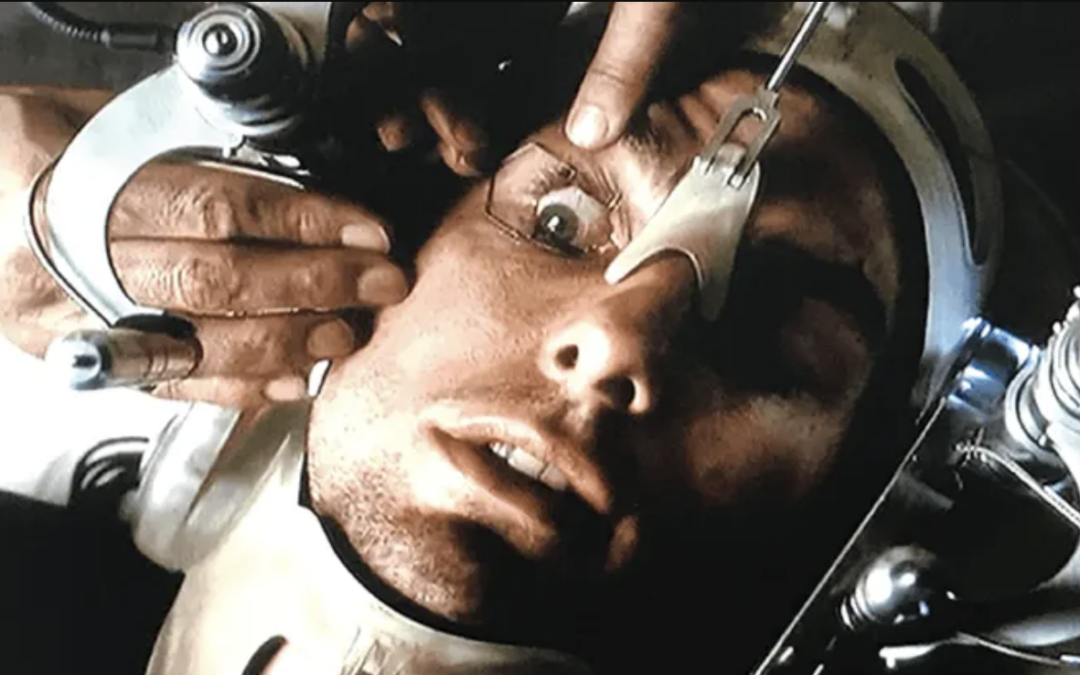
We rank 5 film scenes for eyecare accuracy
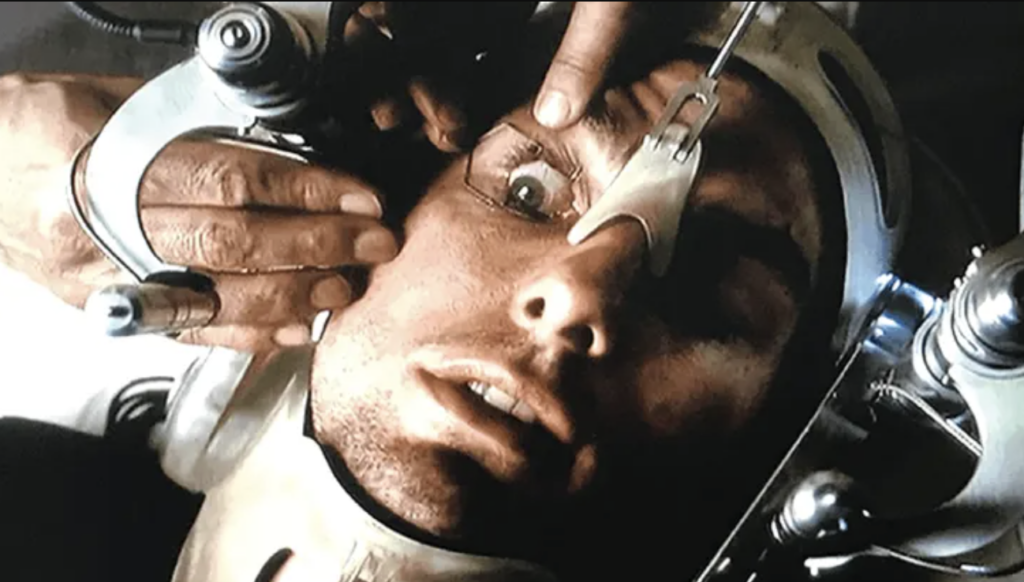
There are a lot of common misconceptions about sight, eyecare and how eye surgery works, and many are probably due to what people see in film and television.
For example, there is non-zero percentage of people who believe we remove the entire eyeball, operate on it, and then return it to the patient. Some seem surprised to hear that during surgery your eye stays exactly where nature put it. The instruments (or the laser) come to the eye, not the other way round.
Perhaps the following films have something to do with these misconceptions…
-----------------------------------------------------------------------------------
1. Minority Report
Accuracy rating: 2/5
In Minority Report, Tom Cruise's John Anderton gets a black-market eye transplant from a dodgy doctor to evade the city's retinal scanners. He then carries his old eyes around in a zip-lock bag. The film might be partly responsible for the idea that eyes can be swapped like spare parts.
In today’s reality, whole-eye transplantation sits at the very edge of medicine. The world's first was performed in 2023 as part of a face transplant. The donor eye stayed healthy, but it didn’t restore sight. That’s because the optic nerve (a cable of around a million fibres linking eye to brain) can't yet be reconnected.
So, to clarify, Southern Eye does not have a collection of eyes in a fridge waiting for patients. Yes, we can do corneal transplants. However, this means replacing the clear front window of the eye with donor tissue, which is supplied through the New Zealand National Eye Bank. It's delicate, precise work, and nobody's eye leaves their head.
And operating in a disgusting basement without any real hygiene processes? Surgery occurs in sterile theatres with strict infection control. Ours has very good lighting (and absolutely no mouldy sandwiches).
2. Proof
Accuracy rating: 4/5
Jocelyn Moorhouse's debut feature stars a young Hugo Weaving as Martin, a prickly blind photographer who takes pictures of the people and places around him. He then asks others to describe the photos and keeps the descriptions as 'proof' the world really is the way people tell him. Russell Crowe the friend he finally lets himself trust.
What it gets right: Martin isn't given a superpower or a miracle cure. The film is honest about what losing sight can mean for trust and independence. We dropped a point because, like most films, Proof treats blindness as total darkness. Most people who are classed as legally blind still have some useful vision.
3. The Eye
Accuracy rating: 2/5
Jessica Alba certainly raised eyebrows in this supernatural ‘body memory’ horror film. She plays a Sydney, a violinist blinded as a child. When she has a cornea transplant it comes with an unwanted extra: her donor's visions of death.
Of course, it’s not your eyes but your brain that records memories. The cornea is a clear dome of tissue whose job is to bend light into the eye. It can't store anything. Our patients can be confident a corneal transplant comes with improved vision and nothing else.
Credit where it's due, though. When Sydney's sight returns, the world is a confusing blur – one she must learn to make sense of. That part is accurate. When sight is restored after many years without it, the brain often needs time to learn how to interpret what the eyes are sending.
4. Jesus' Son
Accuracy rating: 4/5
Directed by Kiwi filmmaker Alison Maclean, this adaptation of Denis Johnson's short stories has become a cult favourite.
As Billy Crudup and Jack Black’s characters negotiate a drug-fuelled night working as orderlies in an Iowa hospital, a man with a knife buried in his eye socket walks into the ED. The attendant doctor “won’t touch the head”, and requests the help of, among other specialists, “the best eye man – a great eye man.”
The medical science is viable. The eyeball is remarkably strong. Its outer coat, the sclera (the white of your eye), is made of tough, densely packed collagen. The eye also sits in a bony socket cushioned by fat, which lets it shift slightly under pressure. So, an object entering the eye socket can sometimes slide past the eyeball rather than through it.
Where we draw the line is having an orderly casually pulling the knife out. If anything is ever lodged in or around your eye, don't remove it. Keep as still as possible, protect the eye without pressing on it, and get to an ED immediately. Then leave everything to a great eye man (or woman).
5. Mr Deeds
Accuracy rating: 1/5
In Mr Deeds, Steve Buscemi's character ('Crazy Eyes') is a running gag built entirely around the fact his eyes don't line up.
Strabismus is a real and common condition where the eyes point in different directions. It's often confused with 'lazy eye' (which is actually amblyopia: the brain favouring one eye over the other).
Untreated strabismus can lead to amblyopia, especially in children. Adults with strabismus may experience double vision, eye strain, and a lot of unwanted attention. The good news is it can be treated at any age with glasses, patching, or surgery to realign the eye muscles. The other good news is that you shouldn’t worry if you haven’t seen Mr Deeds. It stinks.
-----------------------------------------------------------------------------------
Honourable mentions must go to Blind Fury (Rutger Hauer playing a blind Vietnam veteran fighting mobsters with a sword-cane), Daredevil (Ben Affleck playing a blind lawyer fighting crime with super heightened senses) and Zatoichi (Takeshi Kitano playing a blind masseur and swordsman fighting a gang of yakuza).
Accurate? Not remotely. Entertaining? We'll let you be the judge.